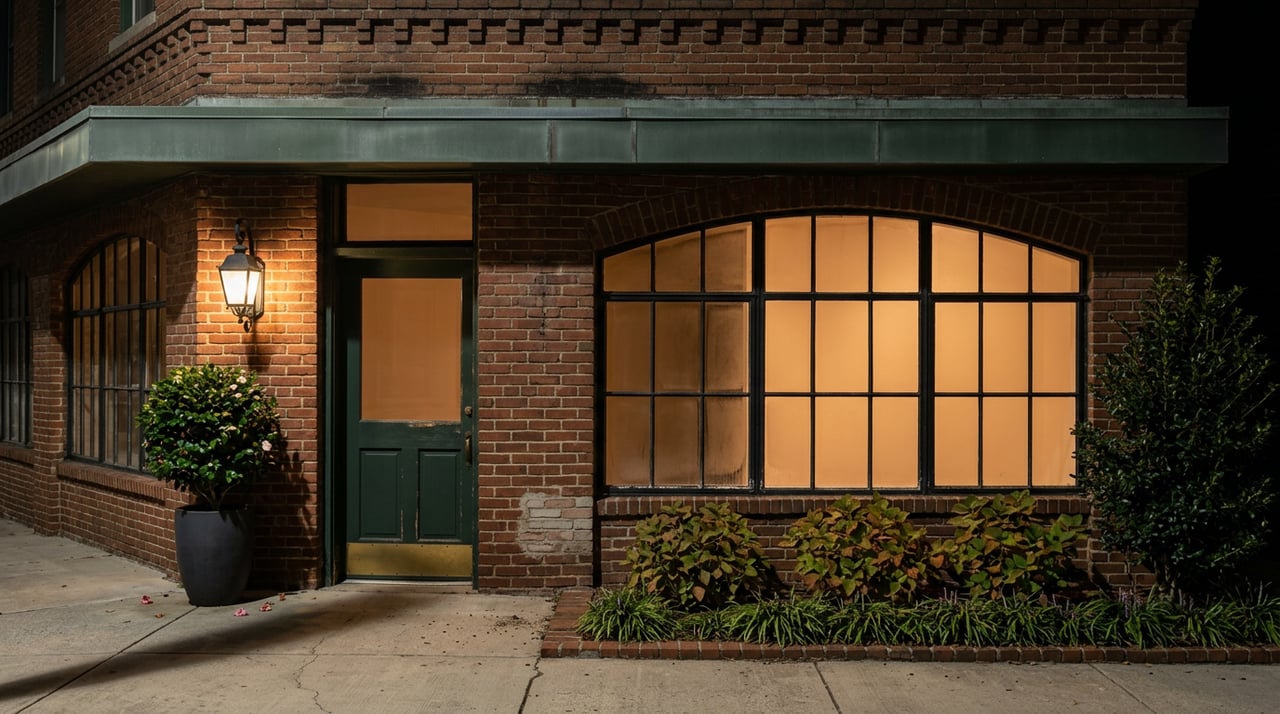
Walk past the corner of Montreat Road most evenings this summer and you'll hear rehearsal drifting out from behind the garage doors of White Horse Black Mountain, the room that used to be a Chevy dealership. It's a familiar sound. What's less familiar is what's happening to the town's signature music weekend this September. After two years of growing, it's shrinking on purpose.
That's the part worth sitting with. The Black Mountain Blues Experience returns downtown September 25 through 27, 2026, and organizers have deliberately capped it at around 200 seats, all indoors, all reserved. A festival that could have chased bigger crowds chose the opposite. Understanding why tells you more about how this town's live music scene actually works than any list of "things to do" ever will.
The Building That Fell Down in January
Start with the venue itself. On January 21, 2026, the former ticket booth at White Horse collapsed during renovation work on the building. This is a nonprofit music venue housed in the historic McMurray Chevrolet Building, a former auto dealership from the 1940s whose vaulted wood ceilings happen to produce excellent natural acoustics. The collapse could have sidelined the place for a season. Instead, White Horse reopened in mid-April, less than four months later, welcoming its first act back to the stage and a full calendar close behind it.
Today, indoor events at White Horse seat between 125 and 220 people, depending on configuration. The venue's next move is bigger literally, not figuratively: a planned rooftop deck and patio that would roughly double total capacity toward 400. "I think we'll definitely be in the 400 neighborhood for inside, patio and deck," said Judi Melton, the venue's director of marketing and community relations, describing the expansion.
That expansion has been a long time coming. When founders Kim Hughes and Bob Hinkle first gutted the abandoned dealership back in 2008, neighbors pitched in to clean and paint alongside them. "It felt like an old-fashioned community barn-raising," Hinkle said of that original effort. The pattern repeats. Something structural gives way, the community rebuilds it, and the room keeps its identity as what White Horse calls a listening room rather than a party space, with tickets still offered on a donate-what-you-can basis.
Same Weekend, New Shape
The Blues Experience is where that identity gets tested against ambition. Here's how the event has actually changed shape over three years:
| Year | Format | What it was solving for |
|---|---|---|
| 2024 | First Black Mountain Blues Festival launched | Launch the event, honor the region's blues history |
| 2025 | Held on the first anniversary of Hurricane Helene, ticketed shows tied to relief fundraising | Community healing and rebuilding support |
| 2026 | Renamed the Black Mountain Blues Experience, moved fully indoor at White Horse, capped near 200 reserved seats | A more contained, focused listening format |
The 2025 event landed on September 27, the anniversary of Helene making landfall in the region. By August of that year, the White Horse Community Fund had raised more than $225,000 toward a $500,000 goal, with proceeds distributed to local organizations including Bounty & Soul, Hammer & Heart, Black Mountain Counseling Center, and Swannanoa Valley Christian Ministry. Ticketed shows that year split net proceeds with hurricane relief.
For 2026, the festival dropped the word "festival" altogether. Organizers wanted something that didn't ask audiences to move between stages, contend with weather, or compete with overlapping sets, the tradeoffs that come with a larger outdoor format. What they built instead is closer to what White Horse has always been: a room where you sit down and stay. The lineup reflects that intimacy without losing ambition. Memphis-based, Grammy-nominated Southern Avenue headlines the Sunday program, and MAMA featuring Melissa McKinney, runner-up in the Band Division at the 2026 International Blues Challenge, is also scheduled, alongside regional performers like Wendy & DaShawn Hickman and Peggy Ratusz & Daddy Longlegs.
Why a Smaller Stage Means a Fuller Sidewalk
Here's the part that matters if you actually live here rather than just visiting for the weekend. A 200-seat indoor show doesn't have room for overflow. That's not a flaw in the plan, it's the plan. When the room fills, the crowd that can't get in doesn't evaporate. It walks downtown, and downtown Black Mountain has spent the last two years quietly rebuilding its own capacity to absorb exactly that.
A short walk from White Horse gets you to a stretch of businesses that tell a similar rebuilding story:
- Hell or High Water, a rooftop restaurant and bar inside the historic Black Mountain Ice House on Broadway Avenue, run by the family behind Foothills Meats. Owners Casey and Amanda McKissick lost property in Old Fort during Helene but pushed ahead with the Ice House project anyway, opening under chef Eric Morris with around 160 seats split across a ground-floor dining room and an upstairs rooftop terrace with mountain views. Dinner runs Wednesday through Sunday, with the rooftop bar open Friday through Sunday afternoons.
- The Trailhead Restaurant & Bar on West State Street, founded by longtime restaurant veteran Michael Flanigan, pours 19 beers on tap, including brews from Black Mountain's own Pisgah Brewing Company, and keeps its outdoor seating dog-friendly for the families it's built around.
- The Bush Farmhouse, known for South African cuisine on South Ridgeway Avenue, made its own comeback after flooding completely during Helene.
- Louise's Kitchen closed for a short stretch in January 2026 to give the old house it occupies some maintenance, then reopened January 29, its porch seating back under the hanging ferns regulars know it for.
None of these businesses exist because of the Blues Experience. But a festival that intentionally caps its own room at 200 seats is, whether organizers frame it this way or not, routing demand into precisely this cluster of places instead of holding it inside a fenced festival footprint. That's a different economic model than a big outdoor event pulls off, and it's one that spreads a single weekend's spending across several small, locally owned businesses rather than concentrating it at one gate.
The Music Doesn't Stop When the Festival Does
The same weekend also shows how little downtown's live music actually depends on one event carrying the whole calendar. Pisgah Brewing Company runs its own concert schedule in Black Mountain independent of the Blues Experience, including a free taproom show on September 2 and ticketed outdoor stage performances on September 19, 26, and 27, the same weekend the Blues Experience is running its own capped indoor program elsewhere in town.
That overlap isn't competition, it's coverage. One venue runs an intimate, seated, 200-person listening room. Another runs a larger outdoor stage with its own separate audience. Together they cover more ground than either format could alone, without either one having to compromise what makes it work.
What This Actually Tells You
The Blues Experience getting smaller isn't a story about a festival losing momentum. It's a venue that just rebuilt from a structural collapse choosing to stay true to what it's always been, a listening room, not a festival ground, even while it plans a literal expansion for later. It's a downtown where restaurants that survived their own disasters are ready to absorb the crowd the festival deliberately doesn't try to hold. And it's a reminder that a town's live music scene isn't measured by the size of its biggest event. It's measured by how many small rooms are running well at the same time.
If you're already living in Black Mountain, none of this requires a plan beyond picking a night in late September and walking downtown. If you're the kind of person who reads a story like this and starts wondering what it would take to actually live somewhere with this much going on within walking distance, I'm always glad to talk through what that looks like in Black Mountain and the surrounding mountain towns. Mark Causby Realty is a phone call or email away. Let's Connect.